Stratega
A flexible research framework for Artificial Intelligence in turn-based strategy games.
2019–2023
Stratega is an open-source framework designed for research on Artificial Intelligence in turn-based strategy games. Developed as part of the EPSRC New Investigator Award “Abstract Forward Models” (EP/T008962/1), the framework provides a highly configurable environment where researchers can rapidly prototype games, implement AI agents, and evaluate planning and learning algorithms under reproducible experimental conditions.
Unlike benchmark environments designed around a fixed collection of games, Stratega enables researchers to define entirely new games through a flexible rule system while maintaining a common interface for AI algorithms. The framework bridges the gap between traditional board games, tabletop games and modern turn-based strategy games, making it suitable for research on planning, reinforcement learning, procedural content generation and game design.
Summary
Stratega was created to provide a modern research platform capable of supporting a wide range of turn-based games without requiring a new engine for every project.
The framework combines a generic game engine with a configurable rule system, enabling researchers to define games, experiment with different AI techniques, and benchmark algorithms within a common software architecture. Research conducted using Stratega has led to advances in Portfolio Search, state abstraction, automatic game balancing, and Artificial Intelligence for strategy games, as well as to the development of new algorithms such as Elastic Monte Carlo Tree Search.
Research Contributions
A General Strategy Game Framework
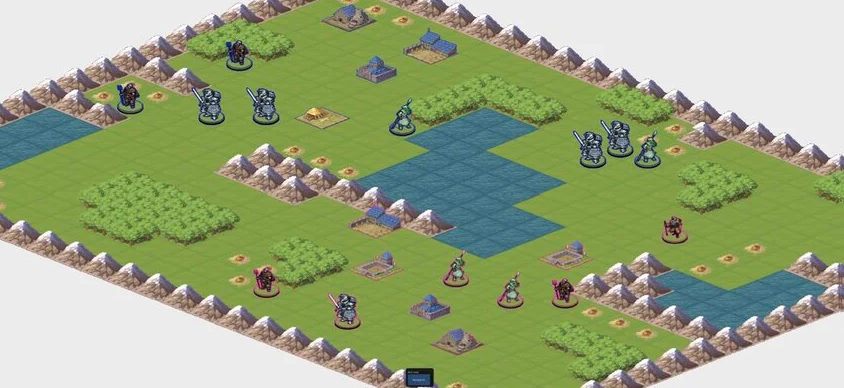
Stratega provides a generic engine for turn-based strategy games where game rules, actions, entities and win conditions are described through a flexible configuration system rather than hard-coded logic.
This allows entirely new games to be created while preserving a common interface for Artificial Intelligence agents. The framework significantly reduces the engineering effort required to investigate new AI algorithms by separating game design from algorithm implementation.
The framework also provides forward models, reference agents, visualisation and experimental functionality, making it possible to investigate algorithms across several different strategy-game environments under a common architecture.
Portfolio Search and Optimisation
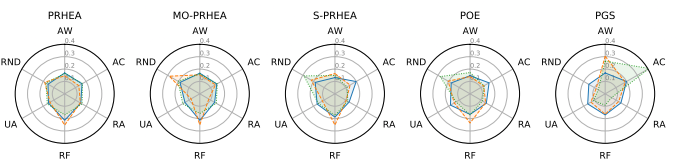
One of the main challenges in strategy games is their enormous action space. Rather than searching directly over primitive actions, this work introduced portfolio search, where the planner selects among a collection of high-level scripts that automatically generate unit actions. By searching over scripts instead of individual actions, the branching factor is dramatically reduced while preserving meaningful tactical decisions.
Building on this abstraction, we developed new portfolio-based planning algorithms, including Portfolio Rolling Horizon Evolutionary Algorithms (PRHEA) and several multi-objective and sparse variants. We also investigated the automatic optimisation of portfolios using NTBEA, demonstrating that automatically generated portfolios consistently outperform manually designed ones across a diverse collection of strategy games.
This work established portfolio search as an effective form of action abstraction, significantly improving both the efficiency and performance of forward planning in Stratega.
Elastic Monte Carlo Tree Search
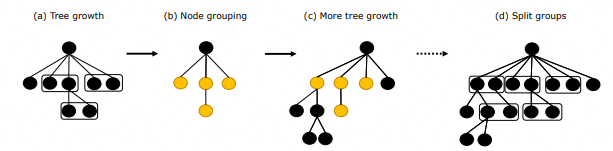
One of the main methodological contributions developed within Stratega is Elastic Monte Carlo Tree Search (Elastic MCTS). This work, led by Linjie Xu with Alexander Dockhorn and Diego Perez-Liebana, investigates how abstraction can be dynamically adapted during Monte Carlo Tree Search. Instead of using a single fixed representation throughout search, Elastic MCTS can operate at different levels of abstraction and progressively refine the representation when additional detail becomes useful.
The approach addresses an important tension in planning: abstract representations can make search substantially more efficient, but excessive abstraction may discard strategically important information. Elastic MCTS provides a mechanism for balancing these competing requirements during search.
The work was evaluated across strategy-game environments in Stratega and became the basis of a broader research programme on state and action abstraction for General Strategy Game Playing.
Configurable Rule System
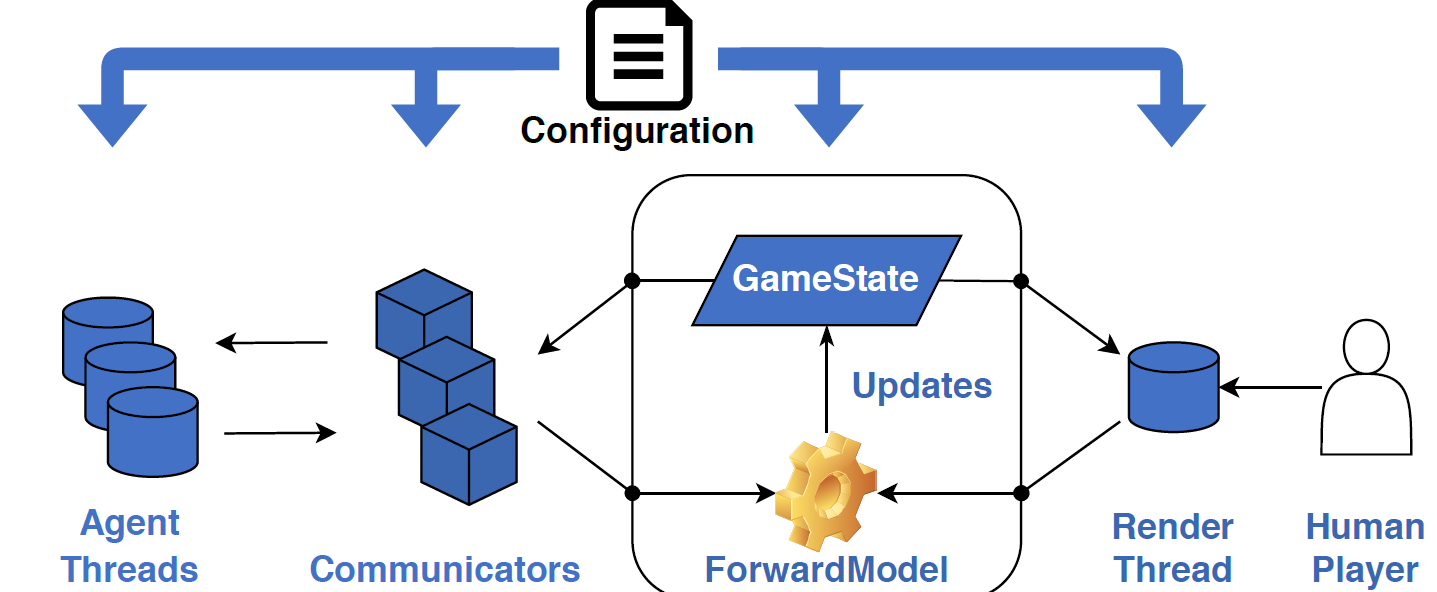
One of Stratega’s defining features is its configurable rule system. Rather than implementing every game independently, game mechanics are represented through reusable components and configuration files, making it possible to prototype new games rapidly while maintaining reproducibility across experiments.
This flexibility enables Stratega to support games with substantially different mechanics while preserving a unified programming interface for AI agents.
The configurable representation is particularly important for research on Abstract Forward Models, because it allows researchers to investigate how different representations of state, actions and dynamics affect the performance of planning algorithms.
Applications
Stratega has supported research across several areas of Game AI, including:
- Statistical Forward Planning
- Monte Carlo Tree Search
- State and action abstraction
- Portfolio Search
- Rolling Horizon Evolutionary Algorithms
- Automatic game balancing
- Point-cost estimation
- General Strategy Game Playing
Its flexibility has enabled researchers to prototype new games rapidly while providing a common benchmark for evaluating different Artificial Intelligence techniques.
Resources
Software
The repository includes:
- Generic strategy game engine
- Configurable rule system
- Forward models
- Reference AI agents
- Visual interface
- Experimental framework
- Documentation
Funding
👉 EPSRC New Investigator Award
Abstract Forward Models for Artificial Intelligence in Games
Grant reference: EP/T008962/1
Stratega was developed as the primary software platform supporting this research programme.
Key Publications
-
📄 L. Xu, A. Dockhorn and D. Perez-Liebana.
Elastic Monte Carlo Tree Search.
IEEE Transactions on Games, 15(4), pp. 527–537, 2023.
👉 PDF -
📄 L. Xu, A. Dockhorn and D. Perez-Liebana.
Towards Applicable State Abstractions: A Preview in Strategy Games.
Reinforcement Learning and Decision Making (RLDM) – RL as a Model of Agency Workshop, 2022.
👉 PDF -
📄 A. Dockhorn, J. Hurtado-Grueso, D. Jeurissen, L. Xu and D. Perez-Liebana.
Game State and Action Abstracting Monte Carlo Tree Search for General Strategy Game-Playing.
Proceedings of the IEEE Conference on Games (CoG), 2021.
👉 PDF -
📄 G. Long, S. Samothrakis and D. Perez-Liebana.
STEP: A Framework for Automated Point Cost Estimation.
IEEE Transactions on Games, 2024.
👉 PDF -
📄 A. Dockhorn, J. Hurtado-Grueso, D. Jeurissen and D. Perez-Liebana.
Stratega: A General Strategy Games Framework.
AIIDE-20 Workshop on Artificial Intelligence for Strategy Games, 2020.
👉 PDF
Other Publications
-
G. Long, D. Perez-Liebana and S. Samothrakis.
Balancing Wargames through Predicting Unit Point Costs.
Proceedings of the IEEE Conference on Games (CoG), 2023.
👉 PDF -
L. Xu, J. Hurtado-Grueso, D. Jeurissen, A. Dockhorn and D. Perez-Liebana.
Elastic Monte Carlo Tree Search with State Abstraction for Strategy Game Playing.
Proceedings of the IEEE Conference on Games (CoG), 2022.
👉 PDF -
L. Xu, A. Dockhorn and D. Perez-Liebana.
Strategy Game-Playing with Size-Constrained State Abstraction.
Proceedings of the IEEE Conference on Games (CoG), 2024.
👉 PDF -
A. Dockhorn, J. Hurtado-Grueso, D. Jeurissen, L. Xu and D. Perez-Liebana.
Portfolio Search and Optimization for General Strategy Game-Playing.
Proceedings of the IEEE Congress on Evolutionary Computation (CEC), 2021.
👉 PDF
Legacy
Stratega represents the principal software outcome of the EPSRC New Investigator Award on Abstract Forward Models. Building upon ideas first explored in PTSP and GVGAI, the project shifted the emphasis from fixed benchmark environments towards reusable research infrastructure capable of supporting a broad spectrum of strategy games.
The research conducted with Stratega also produced substantial methodological contributions, particularly in state abstraction, Elastic MCTS, Portfolio Search and automatic balancing.
Many of the ideas developed within Stratega directly influenced subsequent projects including TAG, PyTAG and broader research on Artificial Intelligence for modern tabletop games.